
Why Intelligent Automation Is Reshaping the Future of Food & FMCG Manufacturing
The New Era of Intelligent Manufacturing
For decades, automation in manufacturing was viewed primarily as a means of reducing labor costs. Companies invested in automated production lines, robotic systems, and packaging equipment with one clear objective—to produce more while depending less on manual labor.
That perception has fundamentally changed.
Today’s Fast-Moving Consumer Goods (FMCG) industry operates in an environment where consumers expect high-quality products, rapid innovation, shorter delivery cycles, greater customization, competitive pricing, and sustainable manufacturing practices. At the same time, manufacturers face rising raw material costs, increasing energy prices, labor shortages, stricter food safety regulations, and intense global competition.
In this environment, automation is no longer simply about replacing manpower.
It is about unlocking speed, precision, consistency, visibility, flexibility, sustainability, and profitability across the entire manufacturing value chain.
Organizations that continue to view automation merely as a capital expenditure often struggle to realize its full potential.
Leading FMCG companies see automation differently.
They view it as a long-term strategic investment that enables operational excellence and creates a sustainable competitive advantage.
Having led multiple automation, modernization, and greenfield manufacturing projects across confectionery and food processing industries, one lesson has consistently emerged:
The greatest benefits of automation come not from faster machines—but from smarter manufacturing systems that integrate people, processes, equipment, and data into one intelligent ecosystem.
Why the FMCG Industry Is Accelerating Automation
The FMCG sector is evolving faster than ever before.
Manufacturers must continuously balance competing priorities:
- Increase production capacity
- Maintain consistent product quality
- Reduce manufacturing costs
- Minimize waste
- Improve energy efficiency
- Ensure food safety compliance
- Launch products faster
- Respond to changing consumer demand
- Reduce environmental impact
- Improve profitability
Meeting all these objectives through traditional manufacturing methods has become increasingly difficult.
Automation provides manufacturers with the ability to optimize every stage of production while improving operational performance across the factory.
The discussion is no longer whether automation is necessary.
The discussion is how quickly organizations can implement intelligent automation across the value chain.
Automation Is About More Than Machines
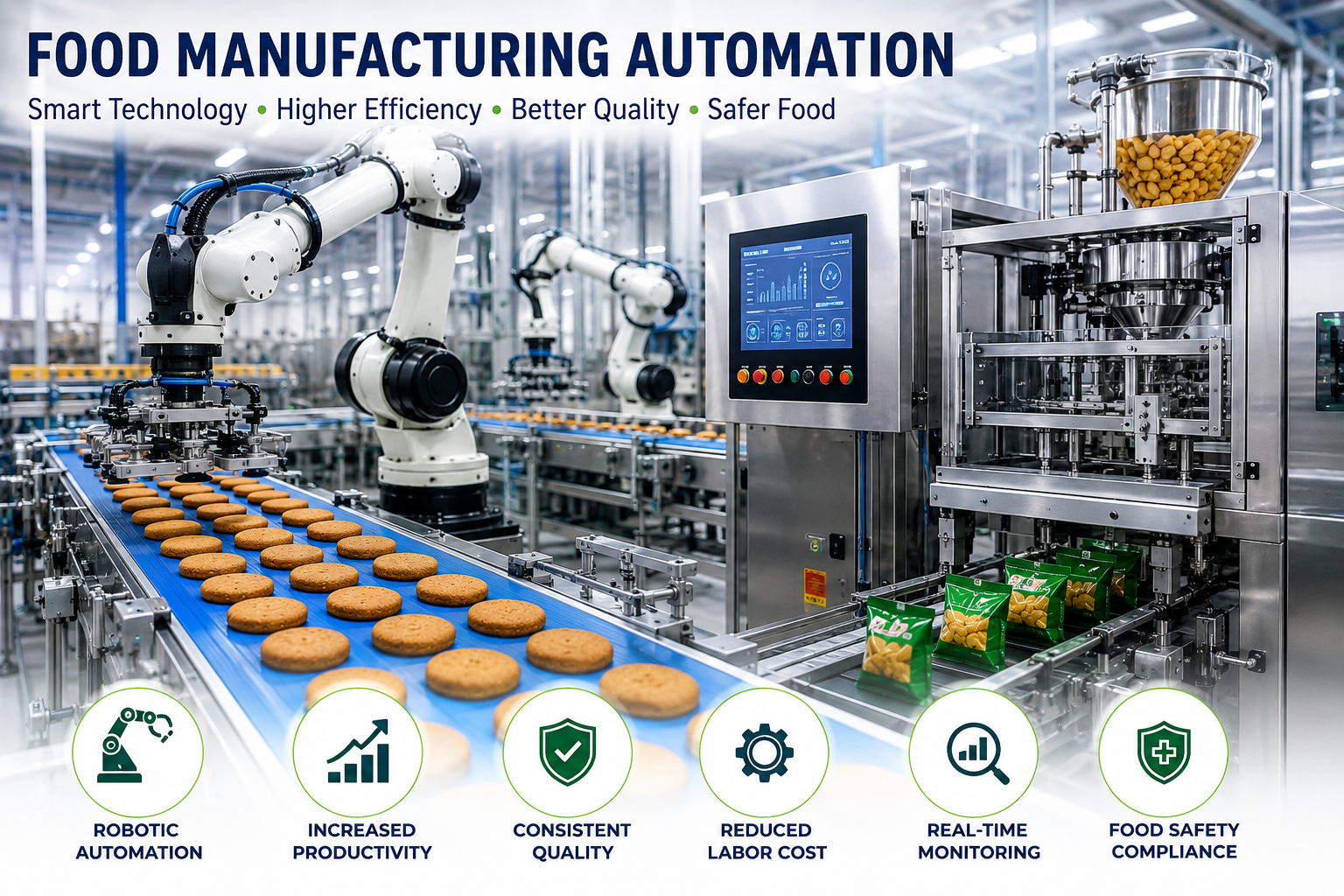
Many organizations still associate automation with conveyors, packaging machines, robotic palletizers, or automated filling systems.
While these technologies remain important, modern automation extends much further.
Today’s digital manufacturing ecosystem integrates:
- Production equipment
- Process control systems
- Manufacturing Execution Systems (MES)
- Industrial Internet of Things (IIoT)
- Artificial Intelligence (AI)
- Machine vision
- Predictive analytics
- Digital quality management
- Enterprise Resource Planning (ERP)
- Utility monitoring
- Data visualization platforms
These technologies work together to create factories capable of making faster, smarter, and more accurate decisions in real time.
Automation has evolved from isolated machines into connected manufacturing intelligence.
Yield Improvement through Real-Time Process Control
One of the most immediate financial benefits of automation is improved production yield.
Every kilogram of raw material lost during production directly reduces profitability.
Even small improvements have significant financial impact.
Advanced process control systems continuously monitor critical manufacturing parameters including:
- Temperature
- Pressure
- Moisture
- Mixing time
- Ingredient ratios
- Product weight
- Flow rates
- Cooking profiles
Rather than relying solely on operator adjustments, automated systems continuously optimize production conditions.
This real-time control reduces process variation and minimizes product losses.
Across multiple FMCG manufacturing projects, intelligent automation has consistently delivered yield improvements of 2–5%, translating into substantial annual savings for high-volume production facilities.
Yield improvement is not simply about producing more.
It is about maximizing the value extracted from every kilogram of raw material entering the factory.
Intelligent Utilities Drive Significant Energy Savings
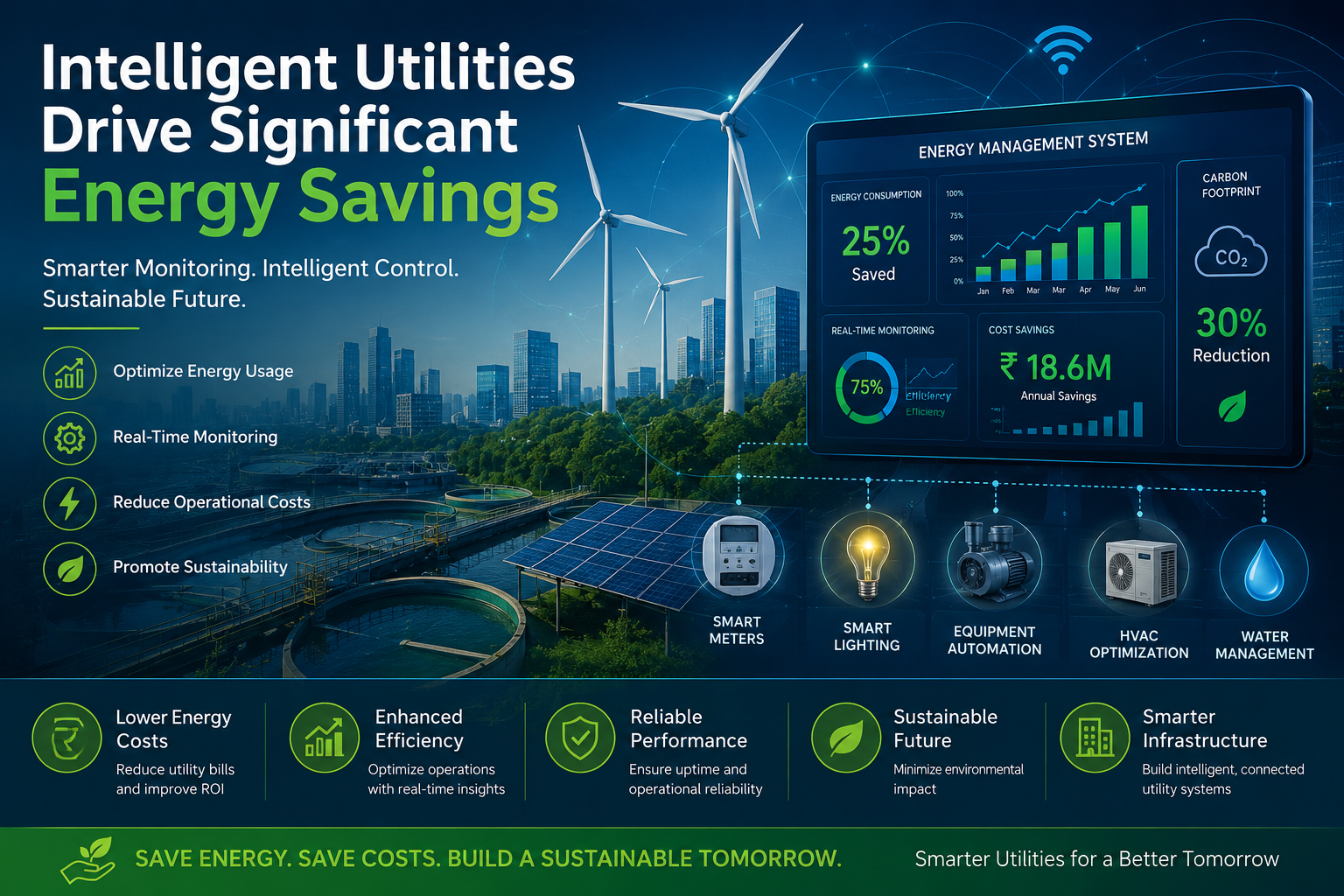
Energy represents one of the largest operating costs in food and confectionery manufacturing.
Steam systems, refrigeration, compressed air, chilled water, boilers, HVAC equipment, and electrical infrastructure consume enormous amounts of energy every day.
Traditional utility management often depends on manual monitoring and reactive maintenance.
Modern automation transforms utility management into a continuously optimized system.
Smart monitoring platforms track:
- Steam consumption
- Boiler efficiency
- Compressed air leakage
- Electrical demand
- Water usage
- Refrigeration performance
- Heat recovery
- Utility load balancing
Real-time dashboards immediately identify abnormalities before they become costly problems.
Intelligent utility management has consistently demonstrated energy savings of 10–20% across modern FMCG manufacturing facilities.
These improvements not only reduce operating expenses but also support corporate sustainability goals and environmental compliance.
Zero-Defect Manufacturing Through Vision Systems
Quality remains one of the most critical competitive factors in FMCG manufacturing.
Consumers expect consistent products regardless of production location or manufacturing batch.
Traditional quality systems often rely on periodic sampling.
While effective, sampling cannot inspect every product.
Modern automation introduces machine vision and inline inspection technologies capable of evaluating every unit produced.
Vision systems automatically detect:
- Packaging defects
- Seal integrity
- Label accuracy
- Fill level
- Product dimensions
- Foreign objects
- Surface defects
- Coding and traceability
Products that fail inspection are automatically removed from the production line before reaching customers.
The result is a significant reduction in defects while improving customer confidence and protecting brand reputation.
Zero-defect manufacturing becomes a realistic operational objective rather than an aspirational goal.
Faster Changeovers Enable Agile Manufacturing
Consumer preferences continue to evolve rapidly.
Manufacturers increasingly produce:
- Smaller batch sizes
- More product variants
- Seasonal products
- Limited editions
- Customized packaging
- Frequent product launches
This environment demands manufacturing agility.
Automation simplifies changeovers by:
- Automatically loading production recipes
- Adjusting machine settings
- Performing equipment calibration
- Validating production parameters
- Reducing operator intervention
Shorter changeover times increase production flexibility while reducing downtime.
Manufacturers can respond faster to customer demand without sacrificing productivity.
Agility has become one of the strongest competitive advantages in modern FMCG manufacturing.
Data-Driven Decisions with MES and Industry 4.0
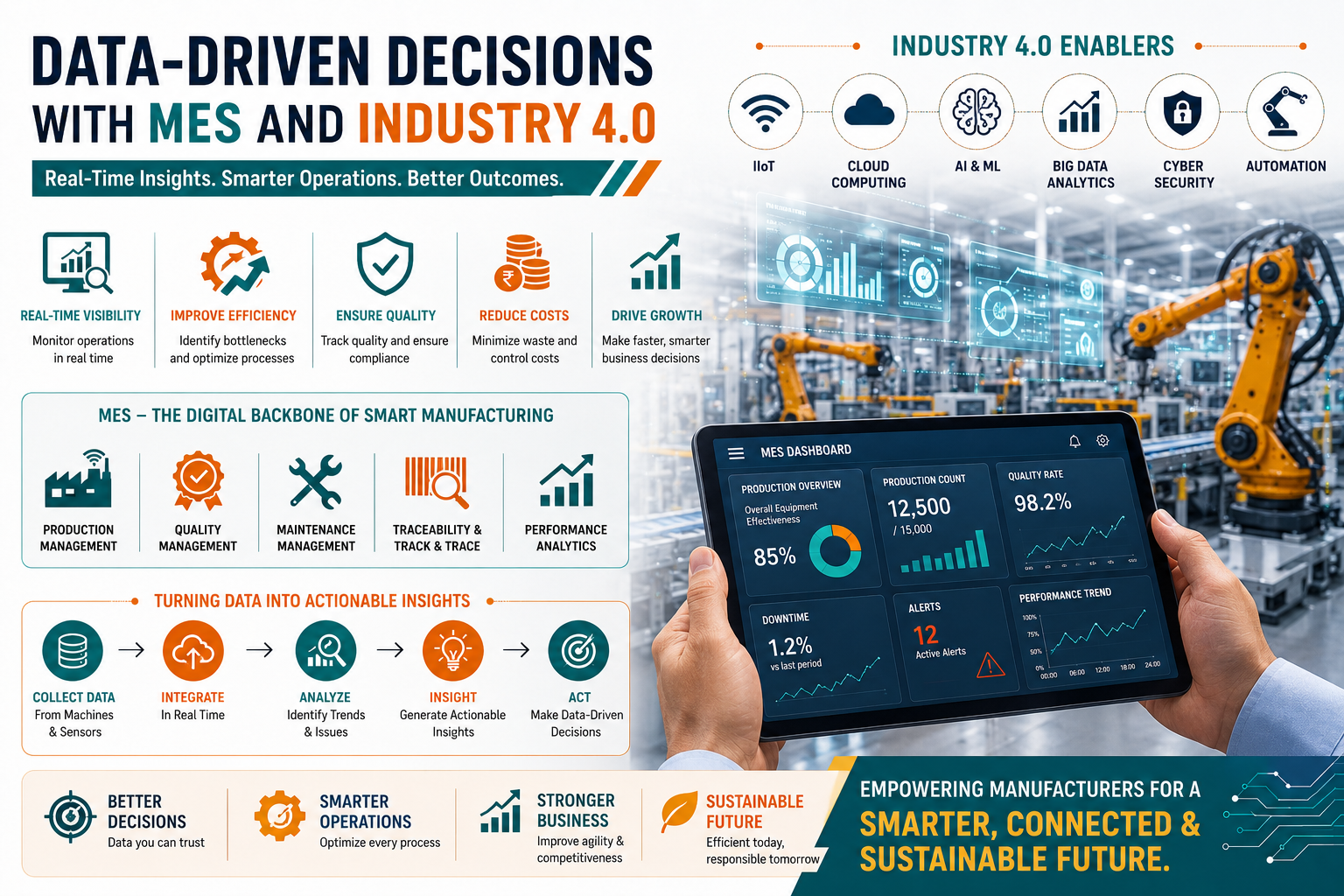
Modern factories generate enormous amounts of operational data every second.
Historically, much of this information remained unused.
Manufacturing Execution Systems (MES), Industrial Internet of Things (IIoT), and Industry 4.0 technologies transform raw data into actionable business intelligence.
Manufacturers gain real-time visibility into:
- Production performance
- Machine utilization
- Overall Equipment Effectiveness (OEE)
- Downtime causes
- Quality trends
- Material consumption
- Energy efficiency
- Workforce productivity
Instead of reacting after problems occur, managers can intervene immediately.
Data-driven decision making improves operational speed, accuracy, and accountability throughout the organization.
Automation Must Become an End-to-End Digital Manufacturing Ecosystem
Perhaps the biggest transformation occurring within FMCG manufacturing is philosophical.
Automation should no longer be viewed as individual machine upgrades.
Instead, manufacturers must create fully integrated digital ecosystems.
A connected manufacturing environment links:
- Raw material receiving
- Production planning
- Processing
- Packaging
- Warehousing
- Utilities
- Maintenance
- Quality assurance
- Supply chain
- Enterprise planning
Every department shares information through one integrated digital platform.
This eliminates information silos and enables coordinated decision making across the entire organization.
Digital manufacturing is not about automating isolated activities.
It is about connecting every activity into one intelligent operational system.
Predictive Maintenance Replaces Reactive Repairs
Equipment breakdowns remain one of the largest hidden costs in manufacturing.
Traditional maintenance strategies rely on scheduled servicing or repairing equipment after failures occur.
Predictive maintenance changes this approach completely.
Using sensors, vibration monitoring, thermal imaging, lubricant analysis, and AI algorithms, manufacturers continuously evaluate equipment health.
Potential failures are detected before production is affected.
Benefits include:
- Reduced downtime
- Lower maintenance costs
- Longer equipment life
- Improved production reliability
- Better spare parts planning
- Higher equipment availability
Maintenance becomes proactive rather than reactive.
AI-Driven Quality Replaces Traditional Sampling
Artificial Intelligence is rapidly transforming manufacturing quality management.
Rather than relying exclusively on random product inspections, AI continuously analyzes production data and visual information.
AI systems can:
- Detect quality trends
- Predict process deviations
- Identify root causes
- Optimize production parameters
- Reduce false rejects
- Improve consistency
Quality evolves from periodic inspection to continuous intelligent monitoring.
Every product benefits from real-time quality assurance.
Smart Scheduling Eliminates Daily Firefighting
Many manufacturing facilities still depend on manual scheduling methods.
Unexpected equipment failures, delayed raw materials, labor shortages, and changing customer priorities frequently disrupt production plans.
Smart scheduling platforms continuously optimize production sequences based on real-time information.
Scheduling decisions automatically consider:
- Machine availability
- Labor allocation
- Inventory levels
- Customer priorities
- Maintenance schedules
- Utility demand
Production becomes significantly more responsive while reducing unnecessary disruptions.
Managers spend less time solving emergencies and more time driving continuous improvement.
Sustainable Manufacturing Through Intelligent Automation
Sustainability has become a strategic business objective rather than a regulatory obligation.
Automation supports sustainability by reducing:
- Energy consumption
- Water usage
- Raw material waste
- Packaging waste
- Carbon emissions
- Product rejects
Real-time monitoring ensures resources are consumed only when required.
Manufacturers simultaneously improve profitability while reducing environmental impact.
Sustainability and operational excellence increasingly reinforce one another.
Final Thoughts
Automation has moved far beyond the traditional objective of reducing labor costs.
Today’s intelligent manufacturing systems improve yield, enhance quality, reduce energy consumption, accelerate production, strengthen sustainability, and enable data-driven decision making.
The most successful FMCG organizations no longer ask:
“Should we automate?”
Instead, they ask:
“How quickly can we scale intelligent automation across our entire value chain?”
Companies that continue to treat automation as a capital expense may struggle to compete in an increasingly digital manufacturing landscape.
Those that embrace automation as a strategic investment are already achieving measurable advantages through:
- Higher productivity
- Lower operating costs
- Greater manufacturing agility
- Improved customer satisfaction
- Stronger sustainability performance
- Consistent product quality
- Faster innovation
- Better profitability
Automation is not about doing the same work faster.
It is about reimagining manufacturing so that every process becomes smarter, every decision becomes more informed, and every resource delivers greater value.
In the years ahead, intelligent automation will not simply support manufacturing excellence—it will define it.