
The Complete Guide to Basic FMCG Terms Every Sales, Marketing & Manufacturing Professional Must Know
The Fast-Moving Consumer Goods (FMCG) industry is one of the world’s largest and fastest-growing sectors, covering products that consumers purchase frequently such as biscuits, chocolates, snacks, beverages, dairy products, personal care items, household cleaners, and packaged foods.
Every day, millions of products move from factories to distributors, wholesalers, retailers, supermarkets, hotels, restaurants, cafés, and finally into consumers’ homes. Behind this massive movement is a common business language made up of specialized terms that every FMCG professional should understand.
Whether you are a sales executive, distributor, business owner, marketing professional, production manager, supply chain specialist, entrepreneur, or student, understanding these terms is essential for making informed decisions and communicating effectively across departments.
From concepts such as SKU, Distribution, Market Share, Coverage, Penetration, FIFO, FEFO, Trade Offers, and HORECA, each plays a critical role in determining how successfully products reach the market and generate revenue.
This comprehensive guide explains the most important FMCG terms in simple language, their practical applications, and why they matter in building successful FMCG businesses.
Understanding the FMCG Business Ecosystem
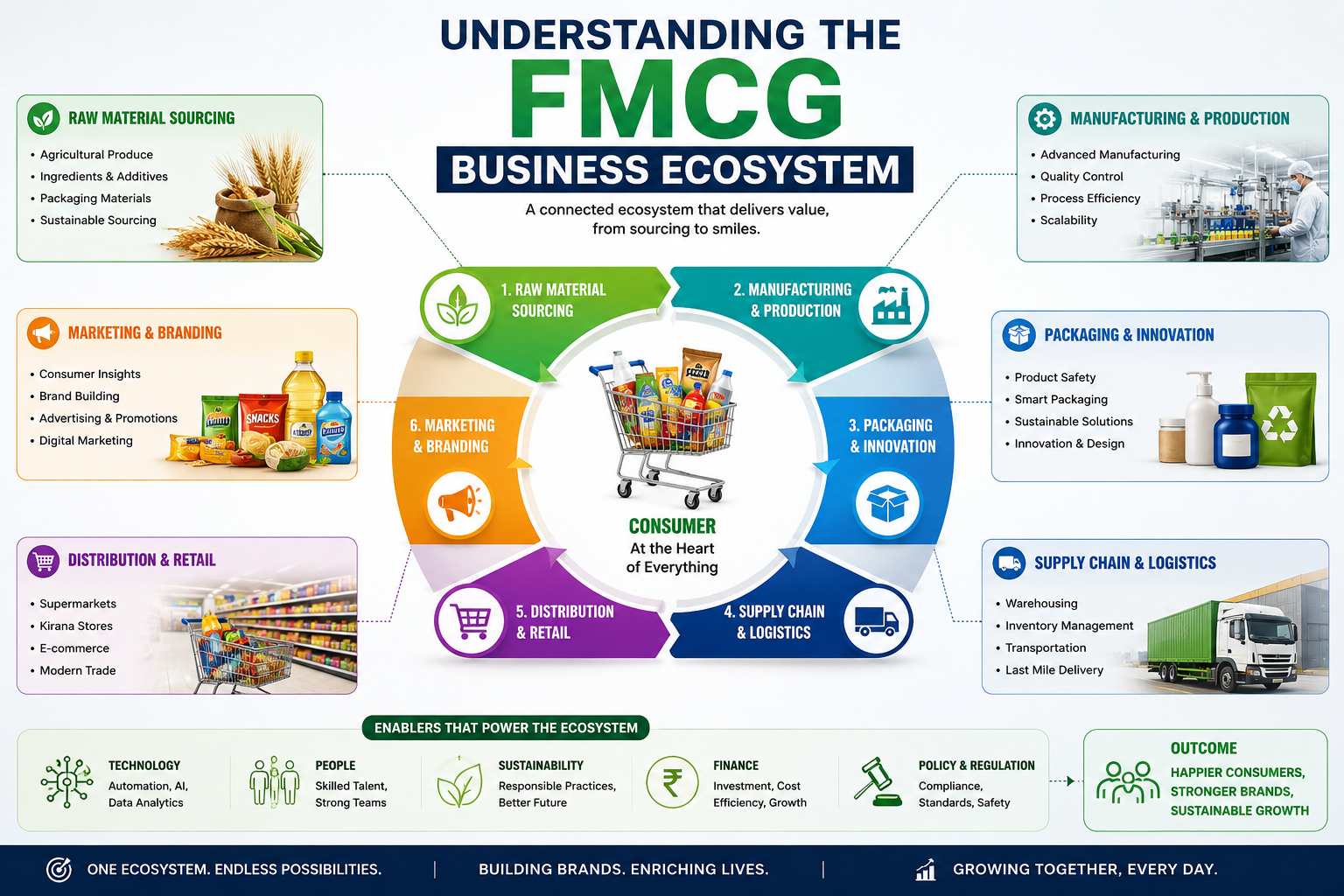
Before learning the terminology, it is helpful to understand how an FMCG business operates.
A typical FMCG supply chain includes:
Manufacturer → C&F Agent → Distributor → Wholesaler / Sub-Distributor → Retailer → Consumer
Each participant performs a specific function:
- Manufacturers produce products.
- Distribution partners move products across markets.
- Retailers make products available to consumers.
- Sales teams ensure visibility, availability, and growth.
- Marketing teams build brand awareness and demand.
Every business function uses common industry terminology.
Let’s explore these key terms.
1. SKU (Stock Keeping Unit)
One of the most frequently used terms in FMCG is SKU.
A Stock Keeping Unit (SKU) refers to every unique product variation that a company sells.
Each combination of size, flavor, packaging, or variant represents a different SKU.
Examples:
- Chocolate 20g
- Chocolate 40g
- Chocolate 100g
- Vanilla Cookies
- Chocolate Cookies
- Family Pack Biscuits
- Single Serve Juice
Although these products belong to the same brand, each is managed separately for:
- Inventory
- Pricing
- Sales tracking
- Demand forecasting
- Production planning
Why SKU Management Matters
Effective SKU management helps companies:
- Reduce excess inventory
- Improve forecasting
- Optimize production
- Increase profitability
- Eliminate slow-moving products
2. Outlet
An Outlet refers to any location where products are sold.
Examples include:
- Grocery stores
- Kirana shops
- Supermarkets
- Hypermarkets
- Pharmacies
- Convenience stores
- Online retail stores
Sales representatives visit outlets regularly to collect orders, ensure product availability, and build retailer relationships.
The number of active outlets directly influences business growth.
3. Coverage
Coverage refers to the number of outlets visited by a salesperson within a specified period, usually daily or weekly.
Higher coverage means:
- Greater market reach
- Better customer relationships
- Improved order generation
- Stronger product availability
Coverage is one of the most important KPIs for FMCG sales teams.
4. Market Share
Market Share measures a company’s percentage of total sales within a product category.
For example:
If the total biscuit market is worth ₹10,000 crore and one company generates ₹2,000 crore in biscuit sales, its market share is 20%.
Market share indicates:
- Brand strength
- Competitive position
- Consumer preference
- Business growth
Companies continuously monitor market share to evaluate performance against competitors.
5. Distribution
Distribution refers to how widely products are available in the marketplace.
Good distribution ensures consumers can easily purchase products wherever they shop.
Types include:
- Numeric Distribution
- Weighted Distribution
- General Trade Distribution
- Modern Trade Distribution
- Rural Distribution
- Urban Distribution
Strong distribution often contributes more to sales growth than advertising alone.
6. Sales Flow
Understanding sales flow is essential for every FMCG professional.
Primary Sales
Manufacturer → Distributor
These represent products sold from the company to distributors.
Secondary Sales
Distributor → Retailer
These represent products moving into retail outlets.
Tertiary Sales
Retailer → Consumer
These represent actual consumer purchases.
Healthy businesses monitor all three sales levels rather than focusing only on primary sales.
7. Penetration
Penetration measures the number or percentage of outlets carrying a company’s products.
For example:
If there are 10,000 retail stores in a city and your products are available in 6,500 stores, your market penetration is 65%.
Higher penetration generally leads to:
- Greater visibility
- Higher sales
- Improved brand awareness
- Stronger retailer confidence
8. Visibility
Visibility refers to how prominently products are displayed inside retail outlets.
Visibility includes:
- Eye-level placement
- End-cap displays
- Shelf branding
- Point-of-sale materials
- Promotional displays
Consumers often purchase products they can easily see.
Better visibility improves impulse buying and strengthens brand recall.
9. FIFO (First In, First Out)
FIFO is an inventory management method.
Products received first should be sold first.
FIFO helps:
- Prevent ageing stock
- Reduce product damage
- Improve inventory turnover
- Maintain freshness
FIFO is widely used across FMCG industries.
10. FEFO (First Expired, First Out)
FEFO differs slightly from FIFO.
Products with the earliest expiry dates should be sold first, regardless of arrival date.
FEFO is especially important for:
- Dairy
- Bakery
- Chocolates
- Snacks
- Pharmaceuticals
- Frozen foods
FEFO minimizes product expiry and reduces waste.
11. Facing
Facing refers to the number of product units displayed at the front of a retail shelf.
More facings provide:
- Better visibility
- Greater consumer attention
- Improved brand recognition
- Higher sales probability
Retail negotiations often focus on increasing shelf facings.
12. MRP (Maximum Retail Price)
MRP represents the highest price consumers can legally be charged.
It includes:
- Manufacturing cost
- Taxes
- Distribution costs
- Retail margins
MRP helps maintain pricing transparency and protects consumers.
13. Trade Offer
Trade offers are promotional incentives provided to distributors or retailers.
Examples include:
- Quantity discounts
- Free products
- Display incentives
- Seasonal schemes
- Cashback
- Retail contests
Trade promotions encourage higher stocking and improve market visibility.
14. Channels
Channels refer to the different routes products take to reach consumers.
The major FMCG channels include:
- Retail
- Wholesale
- HORECA
- Modern Trade
- E-commerce
- Institutional Sales
Each channel has different pricing, logistics, and sales strategies.
15. Retail Channel
Retail includes supermarkets, grocery stores, convenience stores, and neighborhood shops where consumers purchase products directly.
Retail remains the largest FMCG sales channel in many countries.
Success depends on:
- Product availability
- Shelf visibility
- Retail relationships
- Fast replenishment
16. HORECA Channel
HORECA stands for:
- Hotels
- Restaurants
- Cafés (or Catering)
This channel purchases products in larger quantities for food service rather than direct retail sales.
Products supplied through HORECA often require:
- Specialized packaging
- Bulk formats
- Consistent quality
- Reliable delivery
The HORECA segment has become increasingly important for premium food brands.
17. Wholesale Channel
Wholesalers purchase products in bulk from manufacturers or distributors and resell them to retailers.
Advantages include:
- Faster market expansion
- Lower logistics costs
- Better inventory movement
- Increased rural penetration
Wholesale remains an important distribution channel, particularly in developing markets.
18. Target vs Achievement
Every sales representative receives performance targets.
Achievement measures actual sales compared with planned objectives.
For example:
- Monthly Target: ₹10 lakh
- Actual Sales: ₹9 lakh
- Achievement: 90%
Monitoring target achievement helps organizations:
- Evaluate sales performance
- Improve forecasting
- Design incentive programs
- Identify improvement opportunities
Why These Terms Matter in Daily FMCG Operations
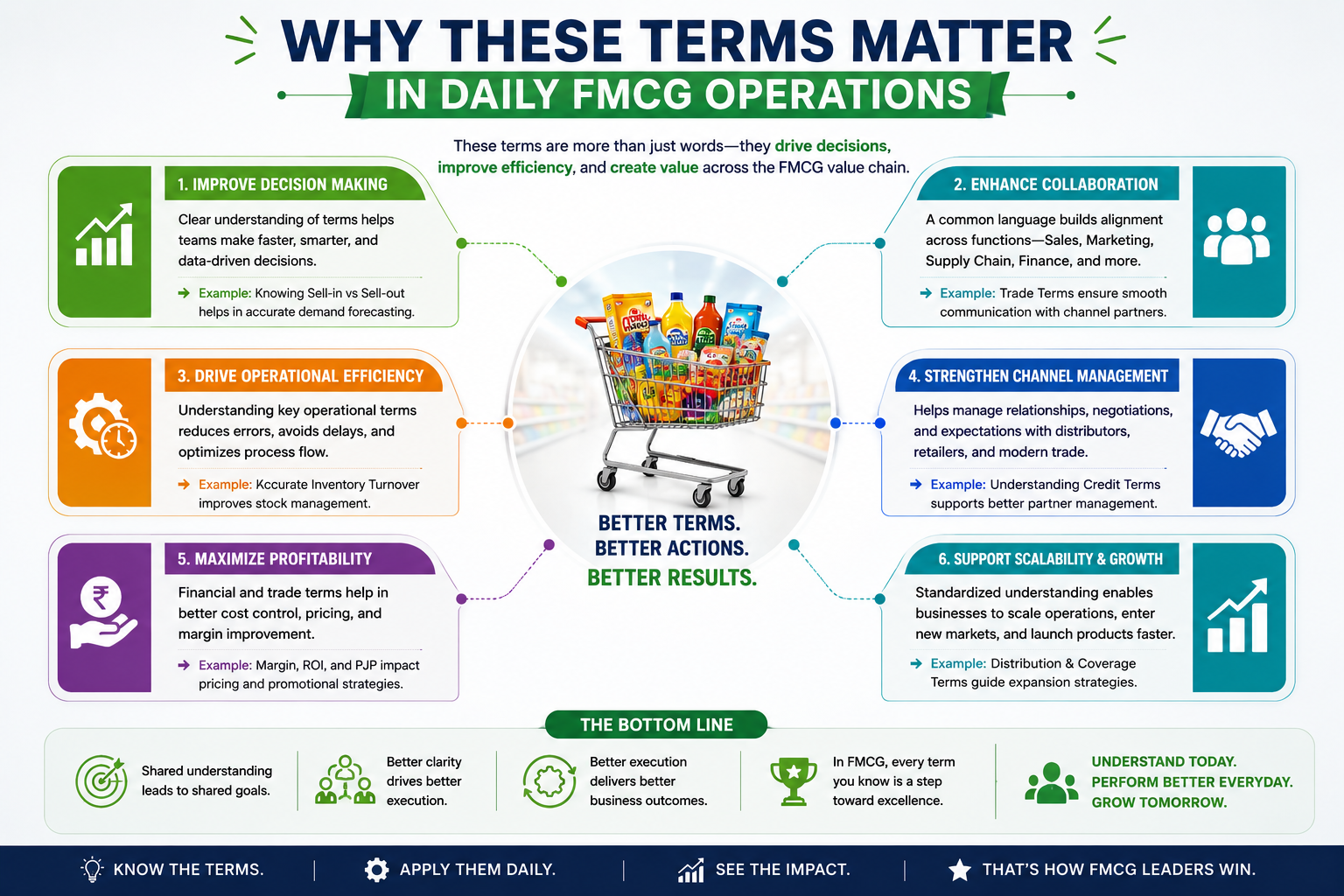
These concepts influence nearly every business decision, including:
- Manufacturing planning
- Inventory management
- Sales forecasting
- Marketing campaigns
- Distribution expansion
- Retail execution
- Trade promotions
- Customer service
Understanding the terminology allows different departments to work together efficiently.
How Technology Is Changing FMCG Operations
Modern FMCG companies use digital tools to monitor these metrics in real time.
Examples include:
- Distributor Management Systems (DMS)
- Enterprise Resource Planning (ERP)
- Customer Relationship Management (CRM)
- Sales Force Automation (SFA)
- Warehouse Management Systems (WMS)
- Manufacturing Execution Systems (MES)
- Business Intelligence (BI) Dashboards
These technologies improve visibility, forecasting, inventory control, and decision-making.
Common Mistakes Made by New FMCG Professionals
Many newcomers focus only on sales volume.
Successful FMCG professionals also monitor:
- Distribution quality
- Numeric coverage
- Product visibility
- Inventory freshness
- Retail execution
- SKU productivity
- Market penetration
- Customer satisfaction
Balanced performance across these areas creates sustainable business growth.
Best Practices for FMCG Success
Leading FMCG organizations consistently:
- Expand outlet coverage.
- Improve numeric distribution.
- Increase shelf visibility.
- Manage inventory using FIFO and FEFO.
- Monitor sales flow continuously.
- Optimize SKU performance.
- Strengthen retailer relationships.
- Use trade promotions strategically.
- Leverage digital analytics.
- Invest in employee training.
These practices improve profitability while strengthening long-term competitiveness.
The Future of FMCG
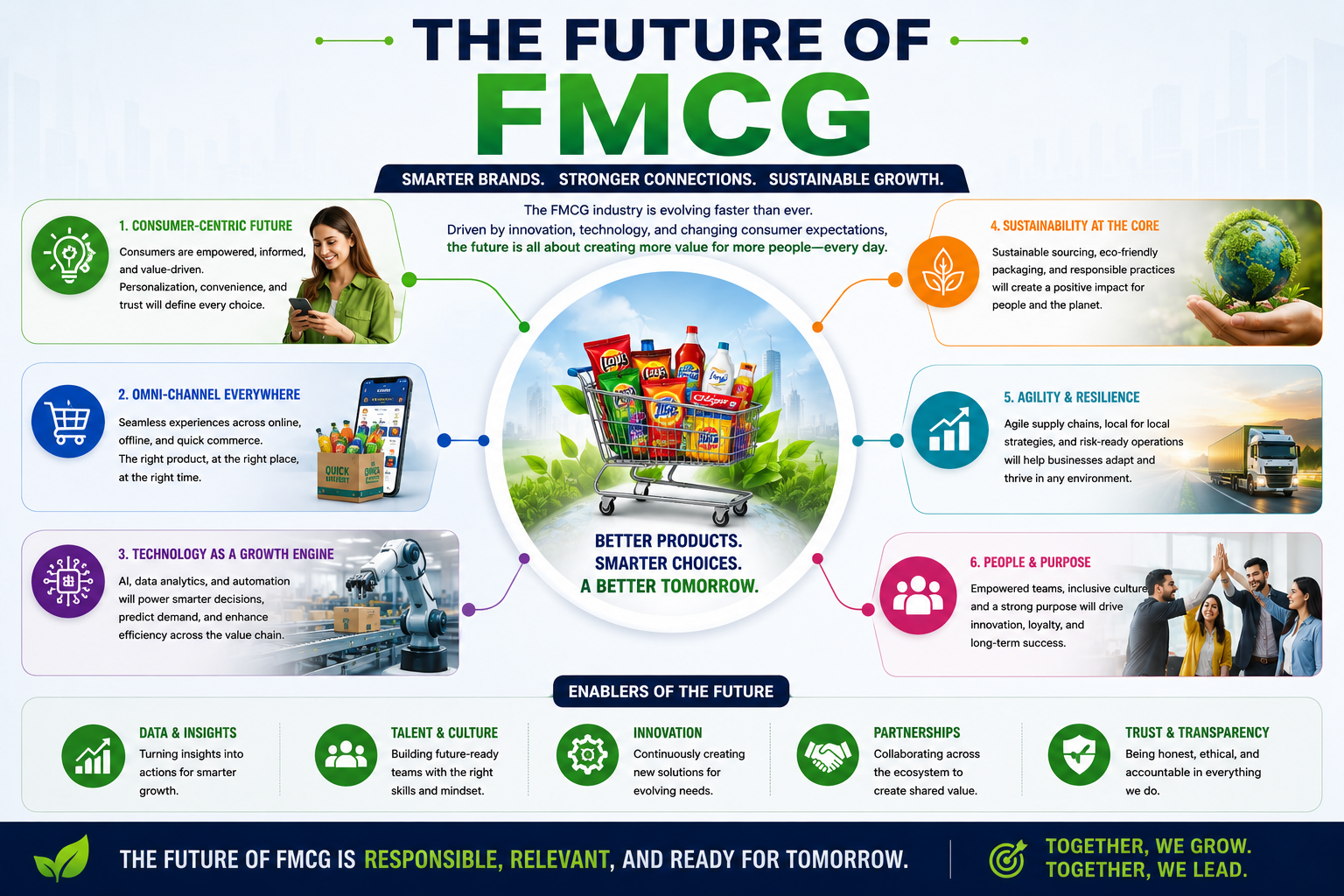
The FMCG industry is evolving rapidly through:
- Artificial Intelligence
- Data Analytics
- Omnichannel Retailing
- E-commerce
- Predictive Demand Forecasting
- Sustainable Packaging
- Digital Supply Chains
- Smart Warehousing
- Automated Distribution
- Consumer Personalization
Professionals who understand both traditional FMCG fundamentals and modern digital technologies will be best positioned for future success.
Conclusion
The FMCG industry moves at incredible speed, and success depends on more than producing quality products. It requires a strong understanding of the terminology that drives daily operations, strategic planning, and execution.
From SKU management and market share analysis to distribution planning, sales flow, FIFO/FEFO inventory practices, trade promotions, and multi-channel selling, every concept contributes to building a more efficient and profitable business.
Whether you are entering the FMCG sector for the first time or seeking to strengthen your professional knowledge, mastering these terms will help you communicate effectively, make better business decisions, and contribute to long-term organizational success.
As the industry continues to embrace digital transformation, these foundational concepts will remain just as important as the technologies that support them. Understanding the language of FMCG is the first step toward becoming a more capable sales leader, marketer, supply chain professional, or manufacturing expert.