
Distribution Excellence in the FMCG Industry: Driving Growth through Efficient Market Reach
Introduction
The Fast-Moving Consumer Goods (FMCG) industry is one of the most competitive and dynamic sectors in the global economy. Products such as food, beverages, personal care items, household goods, and over-the-counter medicines are consumed daily by millions of people. In this highly competitive landscape, success depends not only on manufacturing quality products but also on ensuring that these products are available at the right place, at the right time, and at the right price.
This is where Distribution Excellence plays a crucial role. Distribution excellence refers to the ability of an FMCG company to create an efficient, responsive, and scalable distribution network that ensures maximum product availability while minimizing operational costs. It acts as the backbone of the entire supply chain and significantly influences market penetration, customer satisfaction, and profitability.
Understanding Distribution Excellence
Distribution excellence is the strategic management of the movement of goods from manufacturing facilities to end consumers through various channels. It encompasses planning, warehousing, transportation, inventory management, technology integration, distributor management, and route-to-market optimization.
The primary objective of distribution excellence is to ensure:
- Product availability across all markets.
- Faster delivery cycles.
- Reduced operational costs.
- Improved service levels.
- Higher customer satisfaction.
- Sustainable business growth.
In the FMCG sector, where products have short life cycles and demand fluctuations are frequent, distribution efficiency becomes a key competitive advantage.
Importance of Distribution Excellence in FMCG
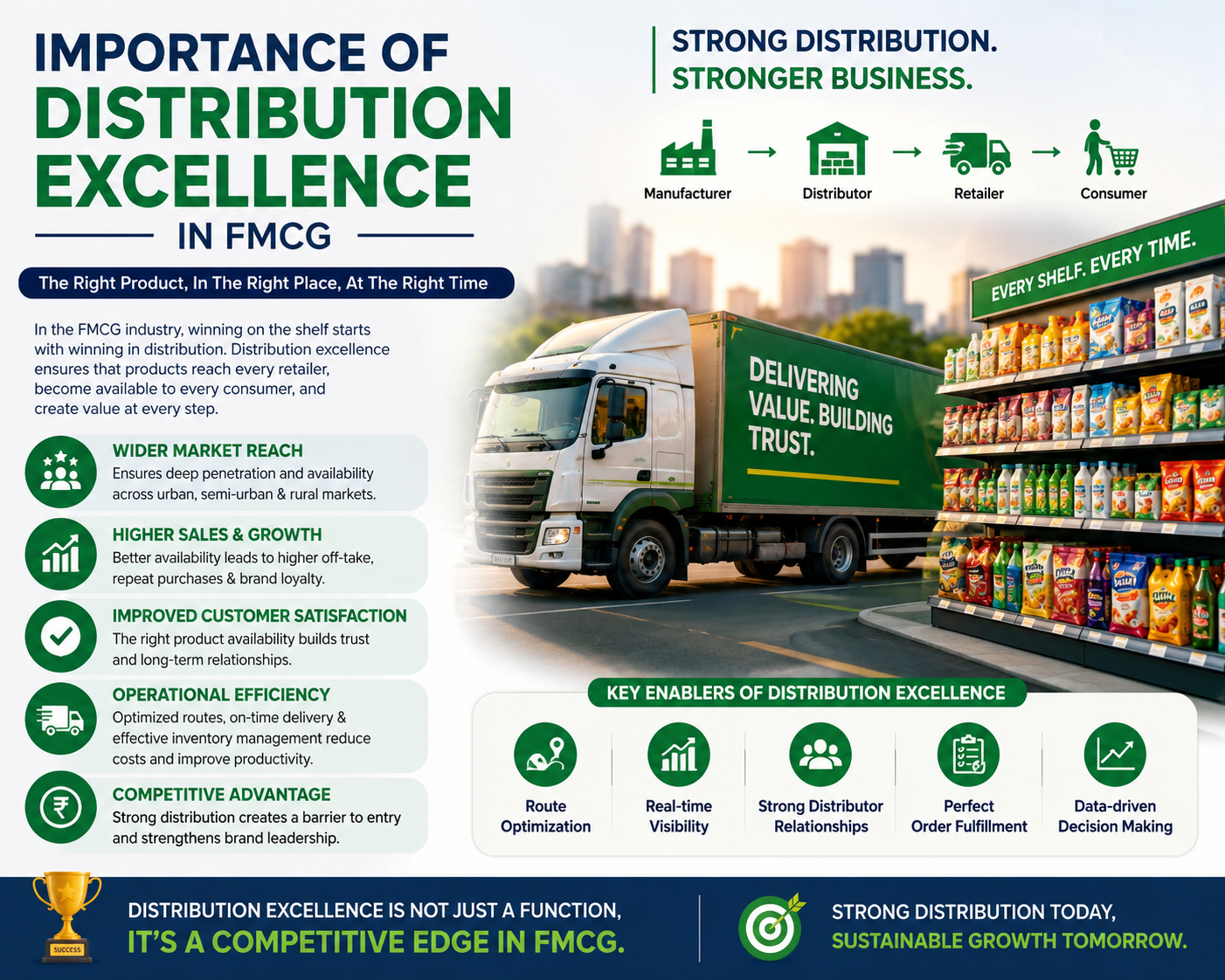
1. Ensuring Product Availability
Consumers expect products to be available whenever they visit retail stores. Even a temporary stock-out can lead customers to switch to competing brands. Distribution excellence ensures continuous product availability and prevents revenue loss.
Benefits:
- Increased market share.
- Improved brand loyalty.
- Reduced stock-out situations.
- Enhanced consumer experience.
2. Expanding Market Reach
A strong distribution network enables FMCG companies to penetrate both urban and rural markets. With the rise of emerging markets and increasing consumer demand, reaching remote areas has become essential.
Key Advantages:
- Wider customer base.
- Higher sales volumes.
- Increased brand visibility.
- Stronger competitive positioning.
3. Reducing Supply Chain Costs
Efficient distribution systems help optimize transportation, inventory holding, and warehousing costs. Lower operational expenses translate into improved profit margins.
Cost Optimization Areas:
- Transportation efficiency.
- Warehouse utilization.
- Inventory carrying costs.
- Order processing expenses.
- Reverse logistics management.
3. Enhancing Customer Satisfaction
Retailers and distributors prefer companies that consistently deliver products on time and maintain adequate inventory levels. Reliable distribution strengthens business relationships and builds trust.
Positive Outcomes:
- Better retailer loyalty.
- Improved service quality.
- Faster order fulfillment.
- Increased customer retention.
Components of Distribution Excellence
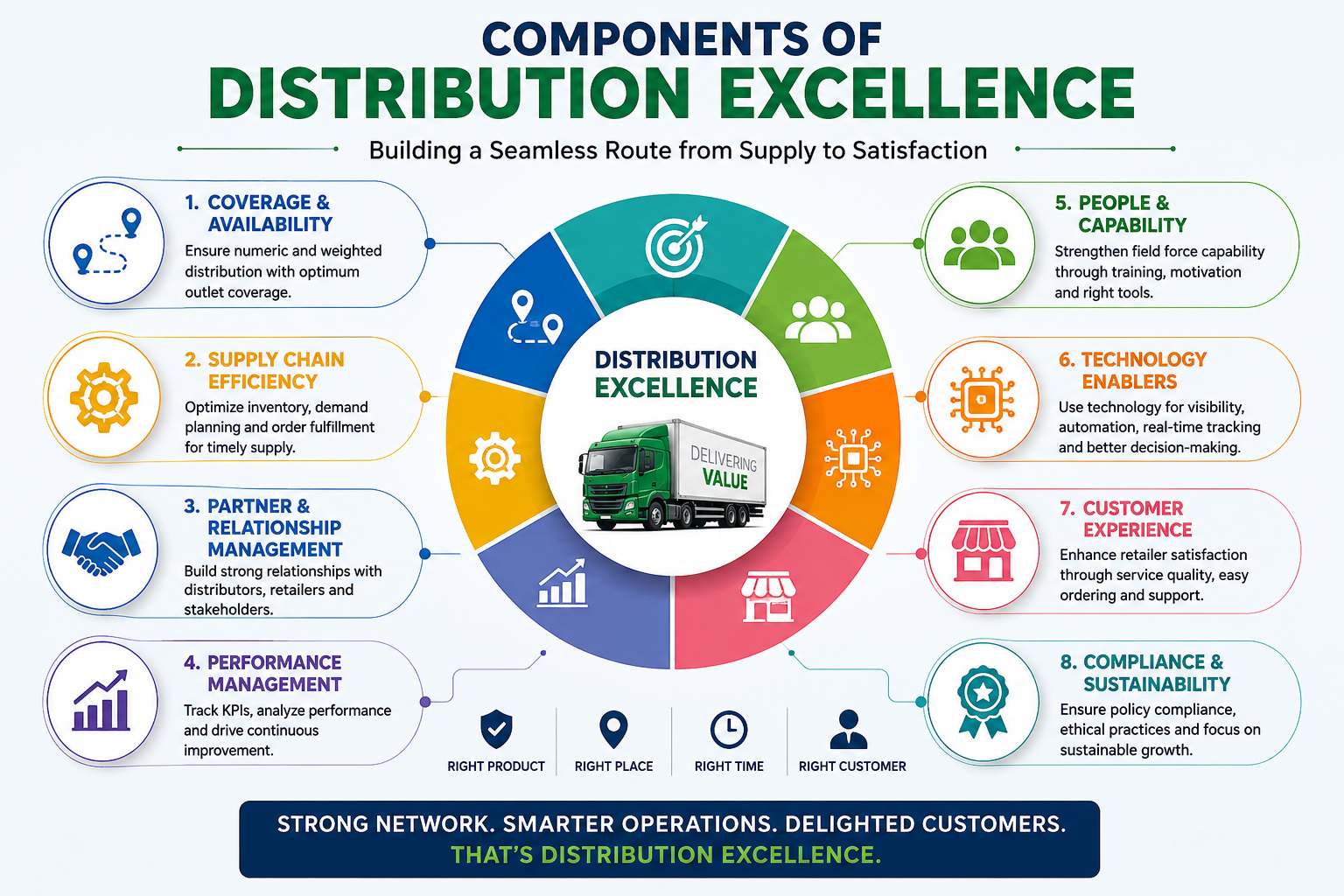
Strategic Distribution Network Design
An optimized distribution network forms the foundation of operational excellence. Companies must carefully determine:
- Number and location of warehouses.
- Distribution centers.
- Transportation routes.
- Market coverage strategies.
- Inventory positioning.
Proper network design minimizes delivery times and operational costs while maximizing market penetration.
Efficient Inventory Management
Inventory is one of the most critical assets in the FMCG industry. Excess inventory increases holding costs, while inadequate inventory leads to stock shortages.
Best Practices:
- Demand forecasting.
- Safety stock management.
- Real-time inventory tracking.
- Automated replenishment systems.
- ABC inventory analysis.
Advanced inventory management ensures the right products are available in the right quantities.
Distributor Management
Distributors act as the bridge between manufacturers and retailers. Strong distributor relationships are essential for achieving market coverage and ensuring consistent product availability.
Effective Distributor Management Includes:
- Performance monitoring.
- Sales target alignment.
- Incentive programs.
- Digital order management.
- Regular training and support.
Companies that empower distributors through technology and collaboration often achieve higher market penetration.
Route-to-Market Optimization
Route-to-market (RTM) strategies determine how products reach customers. An optimized RTM model improves efficiency and reduces delivery costs.
Common Route-to-Market Models:
Traditional Trade
Products are supplied through wholesalers and distributors to local retail stores.
Modern Trade
Products are distributed to supermarkets, hypermarkets, and organized retail chains.
E-Commerce
Online platforms and direct-to-consumer channels facilitate digital sales.
Direct Distribution
Manufacturers directly supply products to retailers or customers.
Hybrid Distribution
A combination of multiple channels to maximize market coverage.
Role of Technology in Distribution Excellence
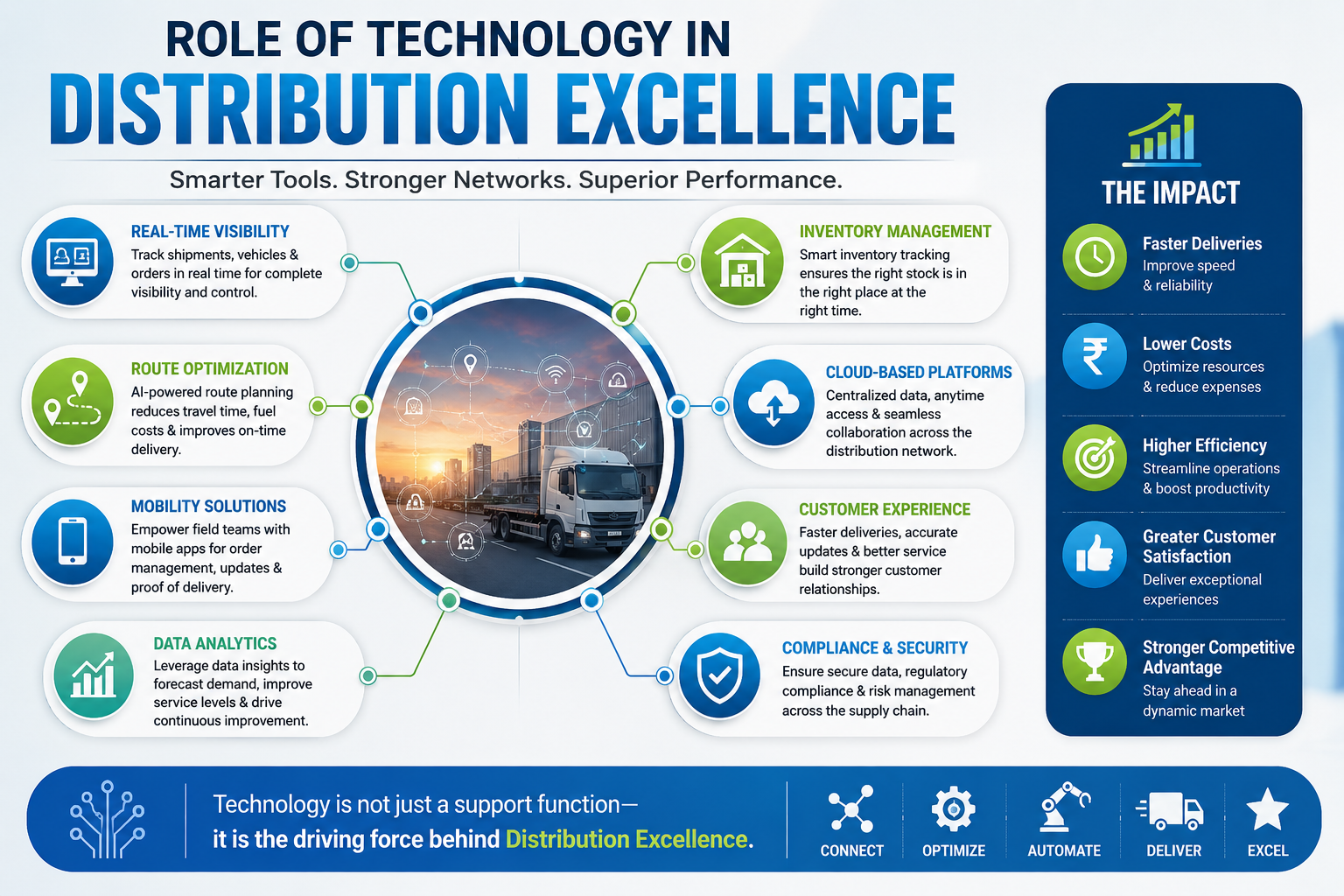
Digital transformation has revolutionized FMCG distribution. Companies are increasingly leveraging advanced technologies to improve visibility and efficiency.
Enterprise Resource Planning (ERP)
ERP systems integrate various business functions and provide real-time information across the supply chain.
Benefits:
- Better inventory visibility.
- Faster order processing.
- Improved coordination.
- Enhanced decision-making.
Warehouse Management Systems (WMS)
Warehouse Management Systems optimize warehouse operations and inventory movement.
Key Features:
- Barcode scanning.
- Inventory tracking.
- Order picking optimization.
- Space utilization management.
- Real-time reporting.
Transportation Management Systems (TMS)
Transportation Management Systems improve logistics planning and route optimization.
Advantages:
- Reduced fuel costs.
- Better fleet utilization.
- Improved delivery accuracy.
- Enhanced shipment visibility.
Artificial Intelligence and Machine Learning
AI-driven analytics help predict demand patterns and optimize inventory levels.
Applications:
- Demand forecasting.
- Sales prediction.
- Dynamic pricing.
- Route optimization.
- Inventory planning.
Internet of Things (IoT)
IoT-enabled devices provide real-time visibility into transportation and warehousing operations.
Capabilities:
- Vehicle tracking.
- Temperature monitoring.
- Asset management.
- Predictive maintenance.
Warehouse Excellence
Warehouses serve as vital hubs in the FMCG supply chain. Efficient warehouse operations directly impact service levels and costs.
Characteristics of an Excellent Warehouse
Accurate Inventory Control
Maintaining precise stock records reduces errors and improves order fulfillment.
Fast Picking and Packing
Efficient processes reduce order cycle times and enhance customer satisfaction.
Automation
Automated systems improve productivity and minimize manual errors.
Safety Standards
Proper safety measures ensure smooth operations and protect employees.
Data-Driven Operations
Real-time analytics enable better planning and performance monitoring.
Transportation Excellence
Transportation accounts for a significant portion of supply chain expenses. Effective transportation management contributes to overall distribution excellence.
Key Focus Areas
Route Optimization
Selecting the most efficient routes minimizes delivery time and fuel consumption.
Fleet Management
Monitoring vehicle performance improves reliability and reduces downtime.
Delivery Scheduling
Proper scheduling ensures timely deliveries and better resource utilization.
Real-Time Tracking
GPS and digital technologies provide complete shipment visibility.
Sustainability
Eco-friendly transportation practices reduce carbon emissions and support environmental goals.
Key Performance Indicators (KPIs) for Distribution Excellence
Measurement is essential for continuous improvement. FMCG companies track several KPIs to evaluate distribution performance.
Order Fill Rate
Measures the percentage of customer orders fulfilled completely.
On-Time Delivery
Tracks the ability to deliver products within the promised timeframe.
Inventory Turnover
Indicates how efficiently inventory is being utilized.
Stock-Out Rate
Measures the frequency of product shortages.
Distribution Cost Per Unit
Evaluates the cost efficiency of distribution operations.
Warehouse Utilization
Assesses how effectively warehouse space is being used.
Perfect Order Rate
Measures the percentage of orders delivered without errors.
Challenges in FMCG Distribution
Despite technological advancements, several challenges continue to impact distribution efficiency.
Demand Volatility
Changing consumer preferences and seasonal fluctuations create uncertainty.
Rising Logistics Costs
Increasing fuel prices and transportation expenses affect profitability.
Rural Market Accessibility
Reaching remote locations remains a challenge in many countries.
Inventory Imbalance
Maintaining optimal inventory levels is difficult due to varying demand patterns.
Supply Chain Disruptions
Natural disasters, geopolitical issues, and global crises can interrupt supply chains.
Increasing Customer Expectations
Consumers expect faster deliveries and higher service levels.
Strategies for Achieving Distribution Excellence
Adopt Data-Driven Decision Making
Analytics and business intelligence tools help organizations make informed decisions and improve forecasting accuracy.
Strengthen Distributor Relationships
Collaborative partnerships with distributors enhance market coverage and service quality.
Invest in Digital Technologies
Automation, AI, IoT, and cloud platforms improve operational efficiency and visibility.
Optimize Route-to-Market Strategies
Companies should continuously evaluate and refine their channel strategies to maximize reach and profitability.
Focus on Continuous Improvement
Lean methodologies and process optimization initiatives help eliminate inefficiencies and improve productivity.
Build Agile Supply Chains
Flexible and resilient supply chains enable organizations to respond quickly to market changes and disruptions.
Emerging Trends in FMCG Distribution
The future of FMCG distribution is being shaped by several trends.
Artificial Intelligence-Based Demand Planning
AI-driven forecasting improves inventory accuracy and reduces wastage.
Omnichannel Distribution
Companies are integrating traditional and digital channels to provide seamless customer experiences.
Direct-to-Consumer Models
Manufacturers increasingly sell directly to customers through online platforms.
Smart Warehousing
Automation and robotics are transforming warehouse operations.
Sustainability Initiatives
Green logistics and eco-friendly packaging are becoming strategic priorities.
Real-Time Supply Chain Visibility
Digital platforms enable complete transparency across the distribution network.
The Future of Distribution Excellence
Distribution excellence will continue to evolve as technology, consumer behavior, and market dynamics change. Future-ready FMCG companies will focus on:
- Digital transformation.
- Artificial intelligence.
- Predictive analytics.
- Sustainable logistics.
- Agile supply chains.
- Enhanced customer experiences.
- End-to-end supply chain visibility.
Organizations that successfully integrate these capabilities will gain a significant competitive advantage and achieve long-term growth.
Conclusion
Distribution excellence is no longer just an operational requirement; it has become a strategic differentiator in the FMCG industry. Companies that develop efficient, technology-driven, and customer-centric distribution networks are better positioned to achieve sustainable growth, improve profitability, and strengthen market leadership.
From inventory management and warehouse optimization to digital transformation and route-to-market strategies, every aspect of distribution contributes to delivering products efficiently and meeting evolving consumer expectations. As the FMCG industry becomes increasingly competitive, organizations that prioritize distribution excellence will continue to outperform their competitors and create lasting value for customers, partners, and stakeholders.